Quick Answer: Yes. Many fake ID websites are associated with payment fraud, identity theft, phishing attacks, and data harvesting schemes. The biggest risk is often losing personal information rather than simply losing money.
Why Fake ID Websites Attract Scammers
The online marketplace for questionable or unregulated services creates an environment where fraudsters can operate with relative anonymity. Many suspicious websites appear professional, but behind the scenes they may exist solely to collect payments or sensitive personal information.
Cybersecurity experts often point out that anonymous websites and irreversible payment methods create ideal conditions for online fraud.
Read Also: List of Best Fake ID Providers & Scams in 2026
Why these sites are attractive to criminals:

Domains can be shut down and relaunched under new names.
Victims may hesitate to report losses.
Cryptocurrency payments are difficult to reverse.
Personal identity documents have high resale value.
The 5 Most Common Fake ID Website Scams

1. Payment Without Delivery
The operator accepts payment and disappears. Emails stop working, and support channels vanish.
2. Identity Theft
Users upload passport scans, selfies, or government ID photos that may later be misused.
Important: A single uploaded ID document combined with a selfie can significantly increase the risk of identity fraud.
3. Cryptocurrency Exit Scams
Many suspicious websites insist on Bitcoin or other cryptocurrencies because they reduce the likelihood of successful chargebacks.
4. Fake Shipping and Customs Fees
Victims may receive repeated requests for “insurance,” “verification,” or “customs clearance” payments.
5. Phishing and Malware
Some websites attempt to install malicious software or collect account credentials through fake login portals.
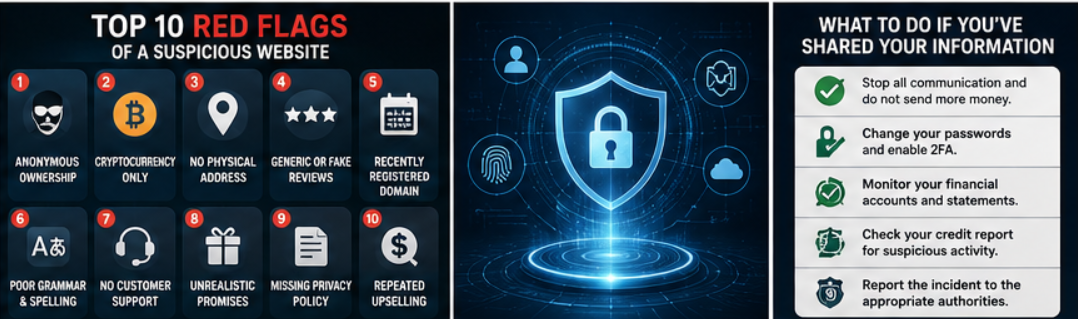
Top 10 Red Flags of a Suspicious Website
| Warning Sign | Why It Matters |
|---|---|
| Anonymous ownership | Difficult to identify operators |
| Cryptocurrency only | Limited payment protection |
| No physical address | Lack of transparency |
| Generic reviews | Could be fabricated |
| Recently registered domain | Common among scam operations |
| Poor grammar | Often associated with low-quality scam sites |
| No customer support | Little accountability |
| Unrealistic promises | Typical social engineering tactic |
| Missing privacy policy | Increased data risk |
| Repeated upselling | Potential extortion behavior |
How Identity Theft Can Happen
Many users underestimate the value of the information they provide online. Criminal groups may combine:
- Government ID photos.
- Selfies.
- Email addresses.
- Phone numbers.
- Payment information.
Together, these data points can be exploited for identity fraud, account takeovers, and social engineering attacks.
What to Do if You Shared Information With a Suspicious Website
If you believe you’ve interacted with a fraudulent website:
✅ Stop sending additional documents or payments.
✅ Change passwords associated with your email account.
✅ Enable multi-factor authentication.
✅ Monitor financial statements and credit reports.
✅ Report suspicious activity to local consumer protection or cybercrime authorities.
Frequently Asked Questions
Are all fake ID websites scams?
Not necessarily, but many anonymous online marketplaces expose users to financial, legal, and cybersecurity risks.
Can your identity be stolen from a photo ID upload?
Yes. Identity documents and selfies can potentially be used in broader identity theft schemes.
Can cryptocurrency payments be reversed?
In most cases, cryptocurrency transactions are significantly harder to recover than credit card payments.
Final Thoughts
The internet contains many websites that promise services they cannot or do not intend to deliver. The most significant risks associated with suspicious identity-related websites are payment fraud, identity theft, and loss of personal data.