
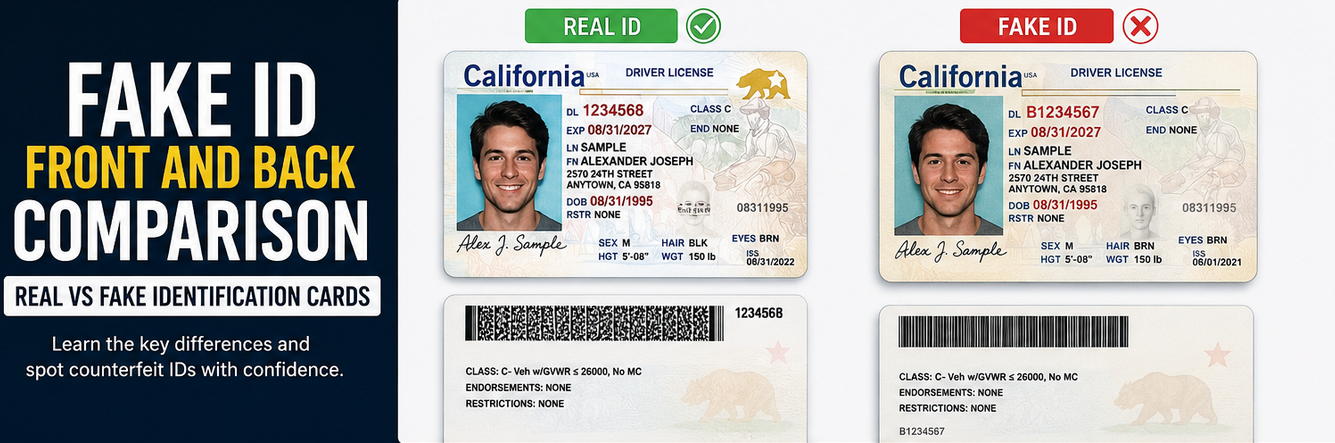
Many people search for fake ID front and back comparisons to understand how counterfeit identification cards differ from legitimate government-issued IDs. Whether you are a business owner, security professional, parent, or simply curious about document security, learning the differences between real and fake identification cards can help prevent fraud and identity-related crimes.
This comprehensive guide will break down:
✅ Key differences between real and fake IDs (front and back)
✅ How to spot a fake ID in seconds
✅ Most common mistakes in fake IDs
✅ Best fake ID states (and why they’re popular)
✅ How scanners and UV lights detect counterfeits
✅ Legal consequences of using a fake ID
By the end, you’ll know exactly what to look for when examining an ID front and back, whether for security purposes or personal awareness.
- Read Also: Top 10 Fake ID Websites Reviewed in 2026.
Fake ID Front vs. Back: Key Differences (Real vs. Fake)
Why Do People Use Fake IDs?
Before diving into the fake ID front and back comparison, let’s understand why fake IDs are in demand:
- Underage drinking & club entry – The #1 reason, with ~20% of underage individuals admitting to using a fake ID to buy alcohol (NIAAA).
- Age-restricted purchases – Tobacco, cannabis (in legal states), and vaping products.
- Online verification bypass – Some platforms require ID for age-gated content.
- Fraud & identity theft – Criminals use high-quality fake ID cards for financial scams.
- Pranks & novelty use – Some buy fake IDs as jokes or collectibles.
With the rise of dark web marketplaces and overseas vendors, obtaining a “best fake ID” has never been easier—making detection harder than ever.
A real ID has dozens of security features, while even the best fake ID often misses subtle details. Below, we compare real vs. fake ID front and back elements.
1. Front of the ID: What to Check
A. Holograms & Overlays
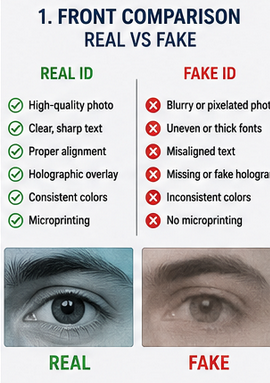
✅ Real ID:
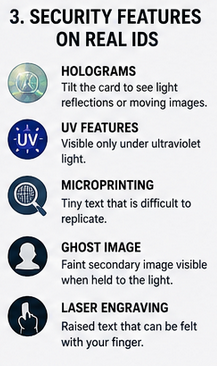
- Multi-layered holograms that shift colors when tilted (e.g., California, Texas, New York IDs).
- Microprinting (tiny text visible under magnification).
- UV ink that glows under blacklight (more on this later).
❌ Fake ID:
- Flat, printed holograms (no 3D effect).
- Blurry or pixelated microprinting.
- Missing or poorly replicated UV elements.
🔍 Pro Tip: Tilt the ID—if the hologram doesn’t change, it’s likely a fake ID front.
B. Photo Quality & Ghost Images
✅ Real ID:
- High-resolution, crisp photo with no pixelation.
- Ghost image (a semi-transparent duplicate photo) that appears when held at an angle.
- Laser-engraved details (some states like Florida and Illinois use this).
❌ Fake ID:
- Blurry or Photoshopped fake ID photo (common in cheap fakes).
- Missing or poorly aligned ghost image.
- No laser engraving (a dead giveaway for scannable fake IDs).
📸 Example: A real Texas ID has a clear ghost image that shifts when tilted—a fake Texas ID often has a static, printed ghost image.
C. Font & Text Alignment
✅ Real ID:
- Perfectly aligned text with consistent spacing.
- State-specific fonts (e.g., New York uses a unique bold font).
- Raised text (some states have tactile lettering).
❌ Fake ID:
- Misaligned or uneven text.
- Wrong font style (a fake California ID might use Arial instead of the official font).
- No raised text (a sign of a cheap fake ID).
🔎 Quick Check: Run your finger over the text—if it’s completely smooth, it’s likely a fake ID card.
D. Signature & Personal Details
✅ Real ID:
- Signature matches the one on file (DMV records).
- Correct abbreviations (e.g., “ST” for Street, “AVE” for Avenue).
- Proper date formatting (MM/DD/YYYY or state-specific styles).
❌ Fake ID:
- Signature looks traced or digital (common in fake IDs from China).
- Incorrect abbreviations (e.g., “St.” instead of “ST”).
- Wrong date format (e.g., DD/MM/YYYY in a U.S. state that uses MM/DD/YYYY).
⚠️ Red Flag: If the fake ID photo looks too perfect (no shadows, overly smoothed skin), it’s likely edited.
Front-Side Comparison
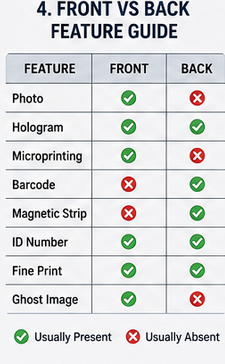
The front of a genuine identification card usually contains a clear photograph, official state or government branding, security holograms, and precisely printed personal information.
Common warning signs of a fake ID front include:
- Blurry or low-resolution photographs
- Uneven text alignment
- Incorrect fonts or spacing
- Missing holographic elements
- Inconsistent colors
- Poor-quality lamination
Real IDs are produced using specialized equipment that creates sharp text and images. Counterfeit cards may look acceptable from a distance but often reveal imperfections upon closer inspection.
2. Back of the ID: Hidden Security Features
Many people focus only on the fake ID front, but the back of the ID often has critical security features that fakes miss.
A. Barcode & Magnetic Stripe
✅ Real ID:
- 2D barcode (PDF417) that scans correctly with ID scanners.
- Magnetic stripe with encoded data matching the front.
- Unique serial number tied to DMV records.
❌ Fake ID:
- Barcode scans as a different name/age (common in scannable fake IDs).
- Magnetic stripe fails or contains gibberish.
- Repeated serial numbers (some vendors reuse numbers).
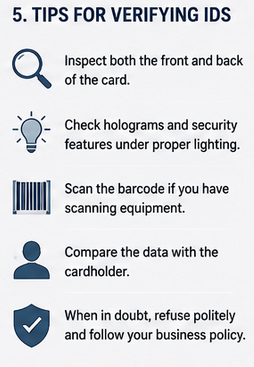
📱 Scanner Test: Use an ID scanner app (like Bouncer ID Scanner)—if the data doesn’t match, it’s a fake ID card.
B. UV & Infrared Features
✅ Real ID:
- Glows under UV light (e.g., Florida IDs have a bright orange UV state outline).
- Infrared (IR) ink visible under special lights (used in new Real IDs).
❌ Fake ID:
- No UV reaction or wrong color (e.g., a fake New York ID might glow green instead of blue).
- Missing IR features (most fake ID vendors can’t replicate this).
💡 UV Light Test: Shine a blacklight—if nothing glows, it’s a fake ID back.
C. Fine Print & State-Specific Designs
✅ Real ID:
- State seals, mottos, or landmarks in intricate detail.
- “For Real ID Act” compliance markings (post-2020 IDs).
- Tactile features (some states have raised patterns).
❌ Fake ID:
- Blurry state seals.
- Missing “Real ID” star (required for federal compliance).
- No tactile elements.
🌟 Example: A real Illinois ID has a detailed Lincoln portrait on the back—a fake Illinois ID often has a low-res version.
Back-Side Comparison:
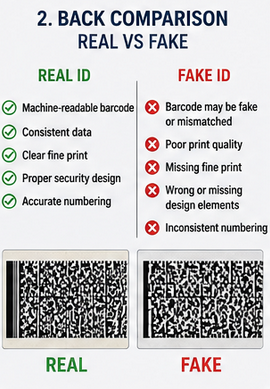
The back of an identification card is frequently overlooked, yet it often contains some of the most important security elements.
Features commonly found on the back of legitimate IDs include:
- Machine-readable barcodes
- Magnetic strips (on some cards)
- Security patterns
- Fine-print text
- Unique identification numbers
A fake ID may contain a barcode that appears authentic but fails to match the information printed on the front of the card. Businesses that use barcode scanners can often detect these inconsistencies quickly.
Most Popular Fake ID States (And Why)
Not all fake IDs are created equal. Some states are easier to fake due to simpler designs, while others are harder to replicate. Here are the top fake ID states in 2026:
| State | Why It’s Popular | Detection Difficulty | Common Fake ID Mistakes |
|---|---|---|---|
| Texas | High demand, simple hologram | Medium | Ghost image misalignment |
| California | Common for underage use | Hard | Wrong UV ink color |
| Florida | Scannable barcodes work well | Medium-Hard | Missing IR features |
| New York | Used for clubs & bars | Very Hard | Incorrect microprinting |
| Illinois | Older designs easier to fake | Easy | Blurry Lincoln portrait |
| Ohio | Less strict bouncers | Easy-Medium | Wrong font style |
| Pennsylvania | Good for East Coast use | Medium | Missing tactile text |
| Michigan | Older IDs still in circulation | Easy | Poor hologram quality |
📌 Pro Tip: Texas, Florida, and California are the most faked IDs due to their scannable barcodes and widespread acceptance.
- Read Also: Full list of Best Fake ID States 2026 USA.
Final Verdict: Can You Spot a Fake ID?
After this fake ID front and back comparison, you should be able to: ✔ Detect a fake ID in seconds by checking holograms, photos, and barcodes. ✔ Know the most faked states (Texas, Florida, California). ✔ Understand the legal risks of using or selling fake ID cards. ✔ Use UV lights and scanners for advanced verification.
Key Takeaways:
- Best fake IDs still fail UV, IR, and scanner tests.
- Real IDs have tactile features, microprinting, and perfect holograms.
- Never risk a felony—if you need an ID, get a real one.
🚀 Need More Help?
- For businesses: Invest in a high-quality ID scanner.
- For parents: Talk to teens about the risks of fake IDs.
- For curiosity: Study real vs. fake ID examples online (but don’t use them illegally!).
FAQs About Fake IDs
Q: What’s the best fake ID state in 2026?
A: Texas and Florida are the most popular due to their scannable barcodes and widespread acceptance.
Q: Do fake IDs work at airports?
A: No. TSA uses advanced scanners that detect fake Real IDs instantly.
Q: Can a fake ID pass a police check?
A: Unlikely. Police have database access and UV scanners that catch most fakes.
Q: How much does a good fake ID cost?
A: $100-$300 for a high-quality scannable fake ID; cheaper ones ($20-$50) are easily detectable.
Q: What’s the punishment for using a fake ID in a club?
A: Varies by state—usually a misdemeanor ($500 fine, probation), but some states (like Texas) can charge a felony.
Conclusion
Whether you’re a bouncer, business owner, or parent, knowing how to spot a fake ID front and back is essential. While fake ID technology has improved, real IDs still have unmatchable security features that scanners and trained eyes can detect.
Final Advice:
✅ If you’re underage, wait it out—the risks of a fake ID aren’t worth it.
✅ If you’re a business, invest in an ID scanner to avoid legal trouble.
✅ If you’re curious, study real IDs to understand what makes them unique.
Stay safe, stay legal, and always verify IDs properly!